CEX and DEX spreads in real time
The scanner finds long/short pairs across exchanges and DEXes, calculates entry, exit, funding and fees, draws the spread chart and sends signals to Telegram.
Best pairs on the market
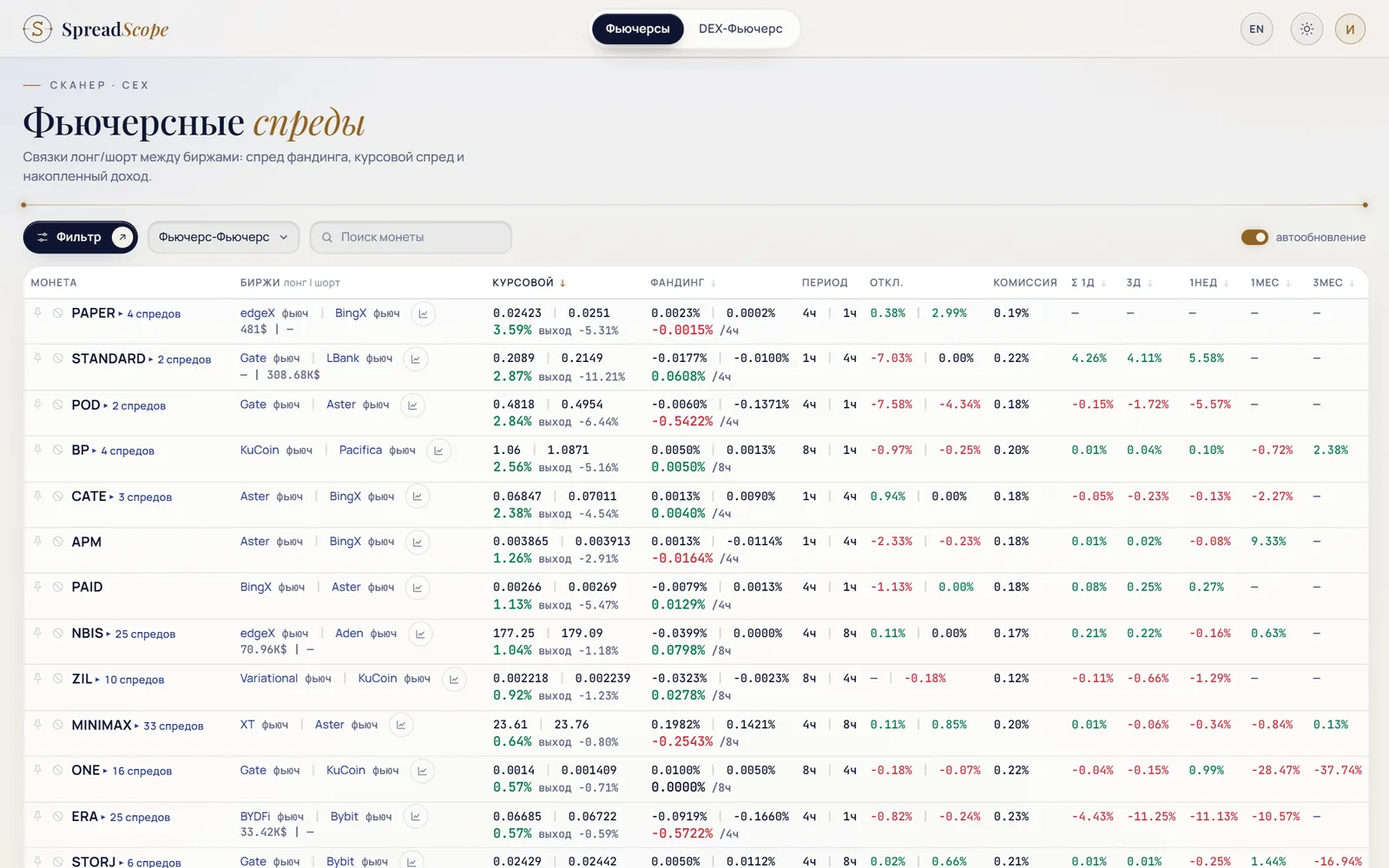
This is what the scanner looks like: pairs between exchanges backed by a real order book. The data here is delayed; in your account it is real-time, with filters, charts and signals.
Entry price spread, before fees and slippage. This is not financial advice.
Open all pairsThree tools in one account
One Telegram account gives you scanners, charts and signals. No passwords.
Futures scanner
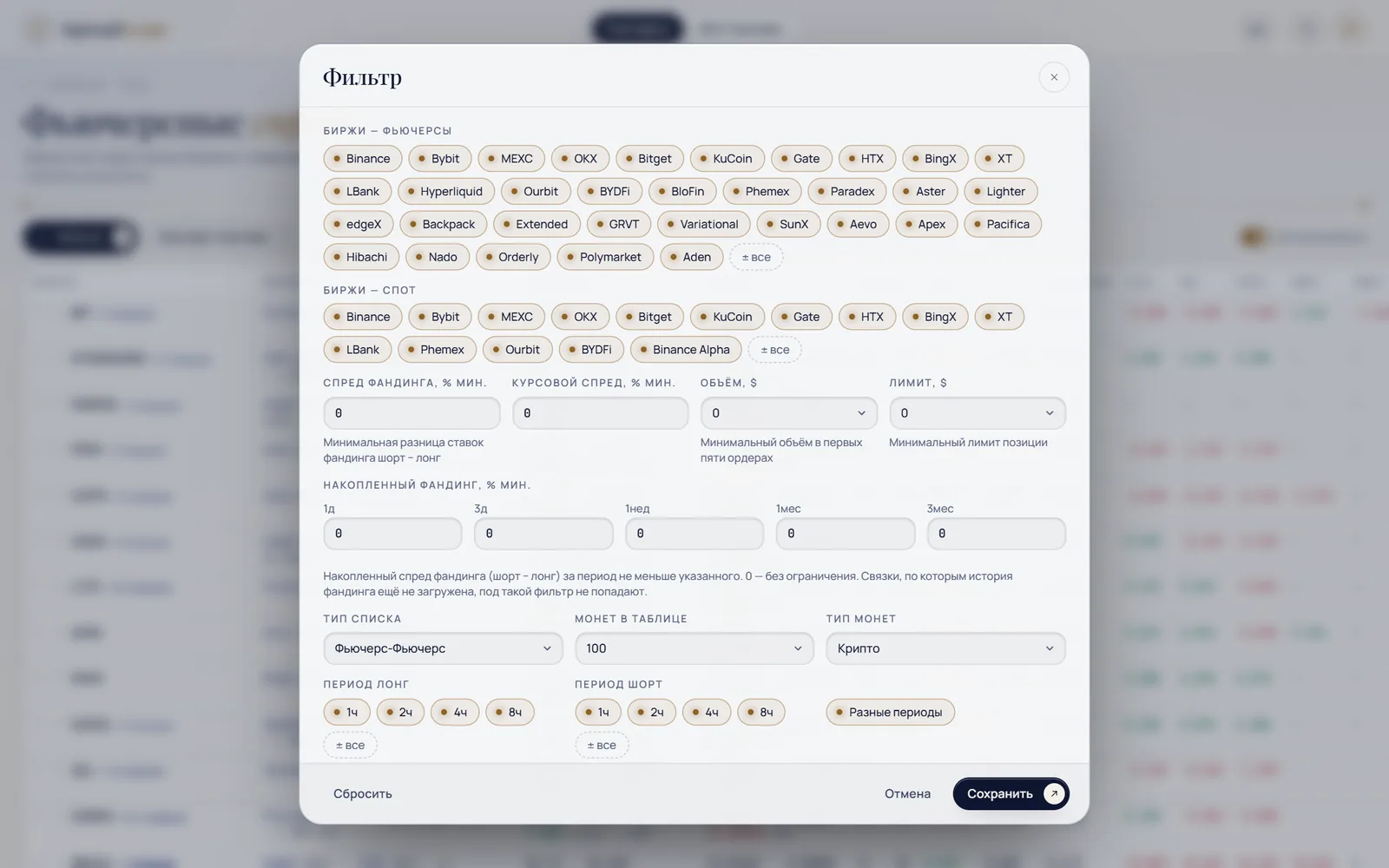
Pairs between futures and spot on different exchanges: price spread, funding spread, limits, fees and accumulated income. One subscription opens all pairs: between CEX, between perp DEXes and CEX ⇄ perp DEX. Every user has their own filters.
DEX → Futures
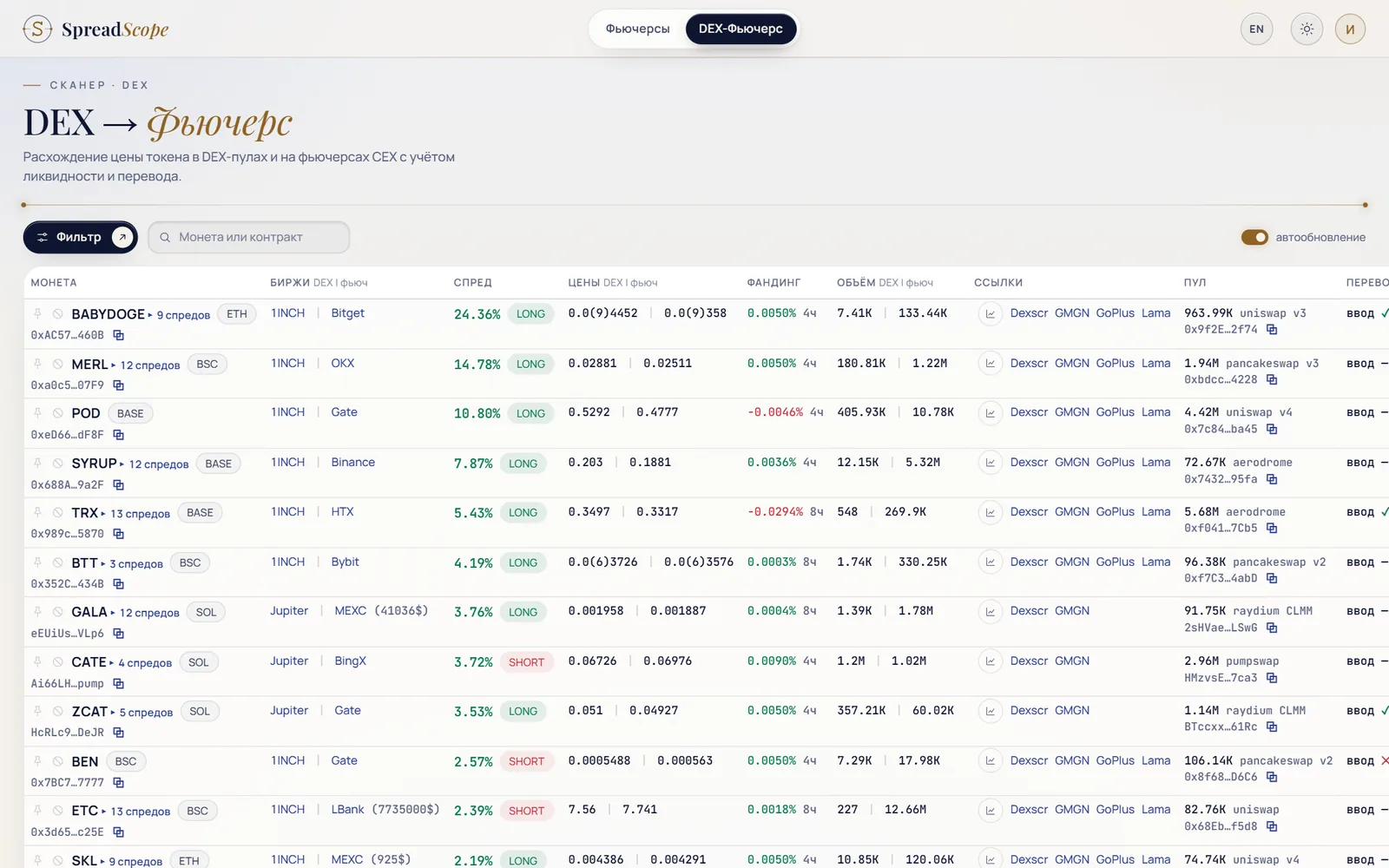
The gap between a DEX pool price and a future: networks, liquidity, token taxes and ready-made swap links.
Charts and signals
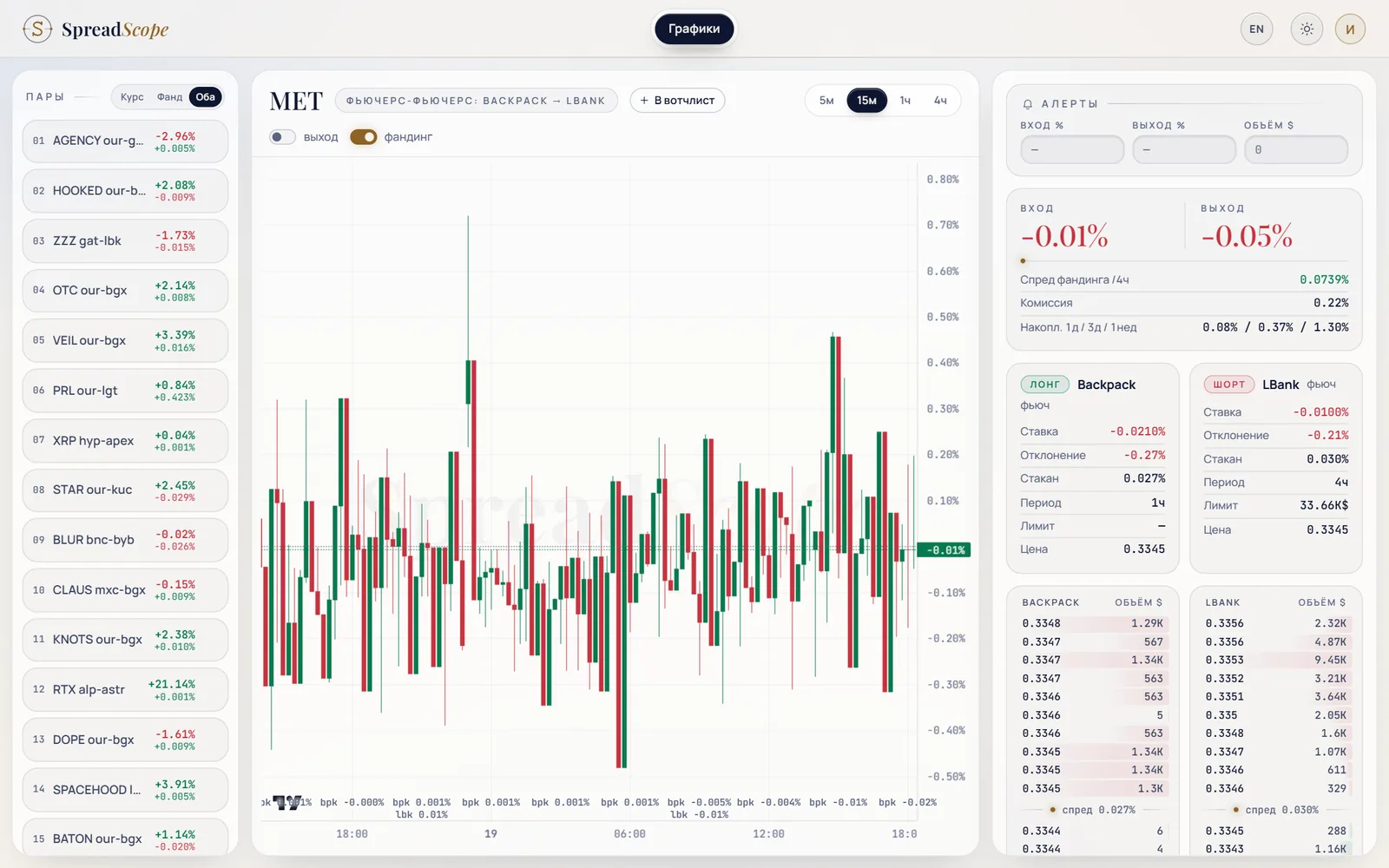
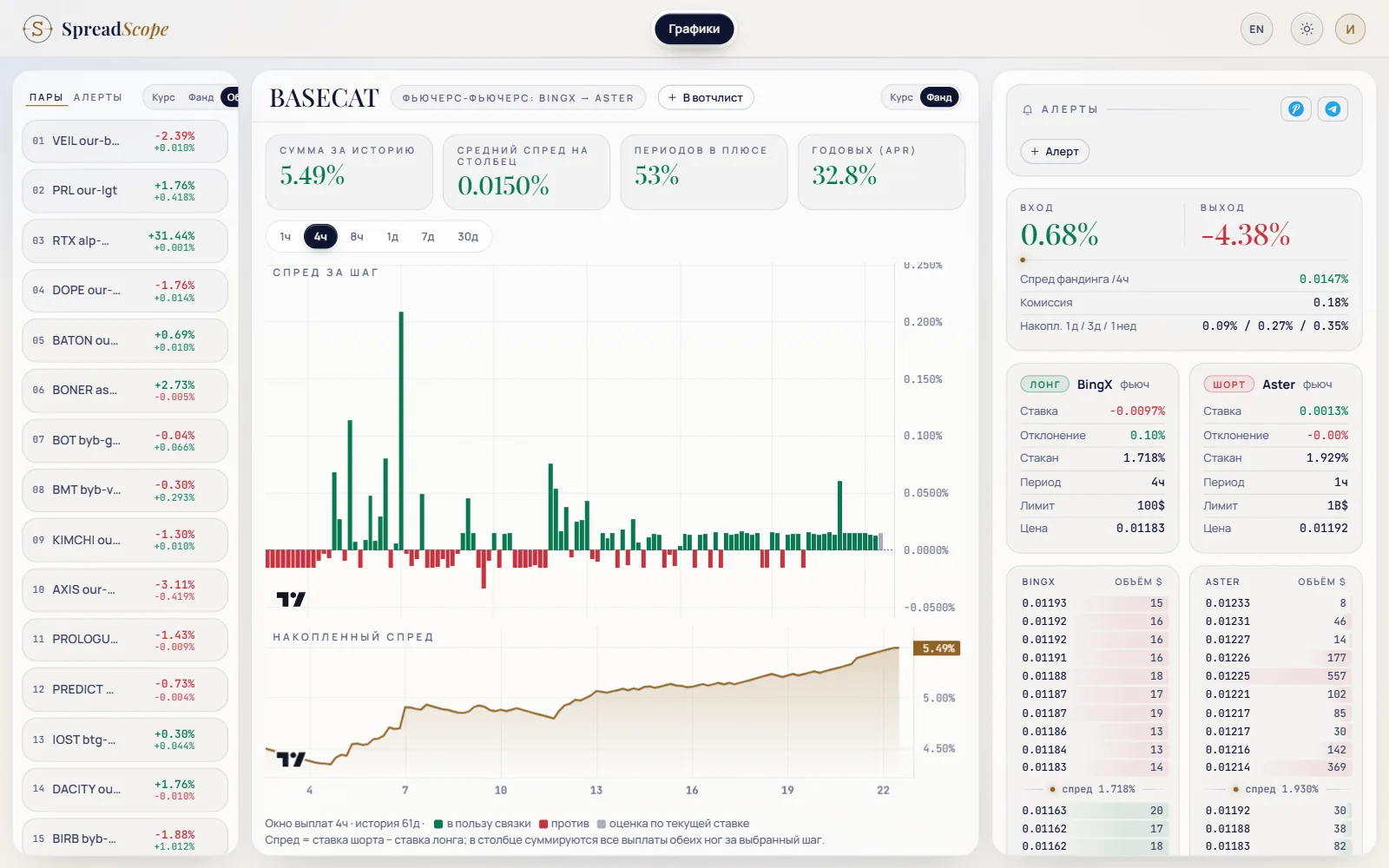
Spread history for a pair with an order book for the amount you need, an exit line and a separate funding spread chart: payouts of both legs in steps from 1 hour to 30 days, the cumulative spread and a forecast of the next payout. Tabs and alerts. Signals for your filter arrive in Telegram, and your own pair alerts also arrive as phone pushes via Pushover, even when the site is closed.
Signals right in Telegram
The scanner runs on the website, and the bots send you what you chose, so there is no need to sit at the table. Start each bot once.
CEX bot
Signals for pairs between CEX exchanges: futures–futures and spot–futures. Your own filters for exchanges, spread, volume and funding, and the “Quiet” button mutes a coin for a while.
DEX bot
Signals for pairs of perp DEXes and DEX pools against CEX futures: spreads, network, pool liquidity and funding.
Push bot
Pair alerts as phone pushes via Pushover. Conditions are built in a constructor: entry, exit, funding spread, price.
Funding cap bot
Sends a message when an exchange’s funding rate hits its cap, and when the payout period or the cap itself changes. Exchanges, threshold, volume and OI are configurable.
How it looks
Venues we monitor
Futures, spot and DEX pools update every few seconds.
Names marked with ↗ are sign-up links. By registering on an exchange through them you support the project; nothing changes for you.
Subscription no surprises
Pay in USDT via CryptoBot or Telegram Stars. Access is enabled automatically.
One CEX + DEX subscription for a month: all pairs between CEX and perp DEXes, including CEX ⇄ perp DEX, and DEX pools against CEX futures.
Frequently asked questions
How do I sign in?
Click “Sign in with Telegram”, open the bot and confirm with the “✅ It is me” button. No password is needed; the account is shared with the bots.
Is there a trial period?
New users get short free trial access to the scanner.
What is included in the subscription?
The CEX + DEX subscription for 1 month opens all pairs: between centralized exchanges (futures–futures and spot–futures), between perp DEXes (Hyperliquid, Lighter, Paradex and others), between CEX and perp DEX, plus the scanner of DEX pools against CEX futures.
How does payment work?
An invoice is created in your account: send USDT to the issued address on the BEP20 network (or pay in CryptoBot where available); Telegram Stars are paid in the bot. After payment the subscription turns on by itself; the end date is shown in your account.
Is there a referral program?
Yes. Your personal link is in your account and in the bot (the /ref command). A friend who comes with it for the first time gets bonus days after their first subscription payment (following the link or using the trial does not earn days), and you get subscription days from their payments. Credits arrive automatically.
Is this financial advice?
No. The service shows market data. Fees, slippage, limits and trade risks are your own responsibility.
Guides
How spreads, funding and cross-exchange arbitrage work: in plain language, with formulas and examples.
Funding rate: what it is and how to read it
What the funding rate on perpetual futures is, who pays whom, how it is calculated and how to compare rates across exchanges with different intervals.
Funding arbitrage: how to earn on rate differences
How funding arbitrage on perpetual futures works: a delta-neutral pair, a worked example, fees, payback period and what to check when choosing a pair.
Cross-exchange spread: entry, exit, real result
How to calculate the spread between exchanges from bid and ask, why exit differs from entry and how fees and order-book depth change the real result.
CEX vs perp DEX arbitrage: differences and risks
How a perp DEX differs from a centralized exchange for spread and funding arbitrage: collateral, funding intervals, limits, smart-contract and liquidation risks.
Arbitrage risks: a pre-trade checklist
Risks of spread and funding arbitrage: liquidity, liquidation, rate changes, deposits and withdrawals, outages — and what to check before opening a pair.
What are perpetual futures (perpetual swaps)? How they differ from standard futures
Perpetual futures (perpetual swaps, perps) explained: a futures contract with no expiry, kept near the spot price by funding. How they differ from standard dated futures and spot, margin, risks.